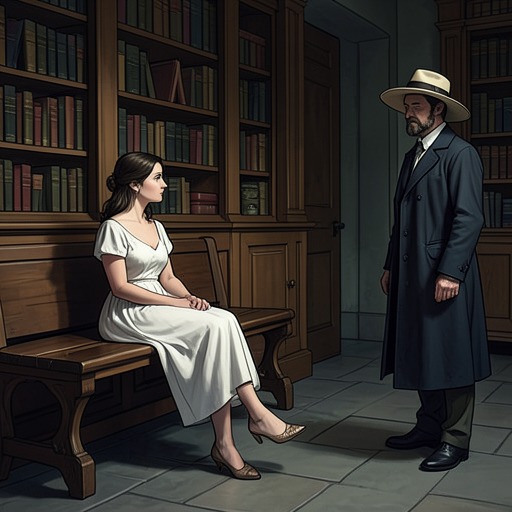
Rose seeks treatment at Gómez’s clinic
Hot MilkRose Papastergiadis’s journey to the Gómez Clinic near Carboneras is both a medical search and a test of the caregiving arrangement between her and her daughter, Sofia Papastergiadis. After years of unexplained symptoms and inconclusive medical attention, they travel to southern Spain in the hope of finding help. The price is substantial: they remortgage Rose’s house to raise €25,000. At the clinic, examinations identify infected ulcers on Rose’s foot, but the larger mystery of her pain remains unresolved. Treatment begins not with a final diagnosis, but with the effort to hear, organize, and reassess a life lived through shifting symptoms and medication.
Background and decision to seek treatment
Rose’s illness has occupied Sofia for much of her life. Sofia recalls asking, at four years old, what a headache meant; Rose described it as a door slamming in her head. By the time they travel to the clinic, Sofia has spent about twenty years trying to make sense of her mother’s symptoms, their triggers, and the treatments prescribed for them. She approaches that long investigation with the habits of an ethnographer, but also as a daughter whose attention is difficult to separate from Rose’s suffering. She understands her mother’s head as if it were her own and casts herself, uneasily, as a detective trying to establish whether an illness can be treated as an unsolved crime.
The family’s previous encounters with medical professionals have not yielded a settled explanation. Rose’s symptoms change, and new complaints bring new prescriptions; doctors in the United Kingdom have even prescribed antidepressants for her feet, which Rose understood to be intended for the nerves. Sofia knows the symptom history is incomplete and unstable, yet remains drawn into interpreting it. The clinic therefore represents more than one more appointment: they have travelled a long way, and Sofia sees the journey as a last chance after years of clinicians being puzzled or resigned.
The cost makes that hope concrete. To pay for treatment, Rose and Sofia remortgage Rose’s house, raising €25,000. The financial commitment weighs heavily because Sofia has been investigating the symptoms for years without finding an answer. Still, the trip offers Rose the prospect of an adventure as well as medical care. For Sofia, the decision joins the household’s economic risk to the emotional labour of continuing to search.
The journey and arrival
A hired taxi carries them toward the clinic through the semi-desert landscape of southern Spain. The ride takes about thirty minutes. Inside the car, the air conditioner makes the desert heat feel like a Russian winter, and Sofia asks the driver to turn it down. When she opens the window, she sees a valley covered in white plastic: greenhouse farms spread across the land like a dull, sickly skin. Rose rests her head on Sofia’s shoulder. Sofia’s own arm still hurts from a recent jellyfish sting, but she does not shift away, knowing her mother is frightened and feeling she must conceal her own fear.
The clinic’s landscaped grounds, described in its brochure as a small oasis, give way to a striking building set into the scorched mountain. Its cream-coloured marble dome resembles an enormous inverted cup, while the entrance is made of glass. The contrast between the clinic’s sheltered gardens and the surrounding stripped landscape frames the arrival as a passage into a place promising care. The deep blue Mediterranean below the mountain briefly brings Sofia a feeling of peace.
Getting inside is itself an effort. It takes fourteen minutes to walk with Rose from the taxi to the glass doors. When the receptionist calls for Rose, Sofia takes her arm, and the two women limp together across the marble floor. Sofia describes matching her mother’s pace as a way of moving forward together: her legs become, in effect, Rose’s legs. Yet Rose had walked alone to a local shop that morning to buy hairpins, without even taking a walking stick. The contrast makes her capacity appear changeable rather than fixed, and unsettles Sofia’s wish to understand her mother through a single account of impairment.
At reception, a nurse brings a wheelchair, and Sofia feels relief when someone else takes over pushing Rose. The relief sits alongside the closeness of their shared walk: care can mean lending an arm, but it can also mean being able to step back. After a long journey from home, the pair reach the consultation room with a sense of pilgrimage and of a last opportunity for help.
Examination and medication review
Dr Gómez, the orthopaedic consultant Sofia has researched for months, begins by examining Rose’s feet. When Sofia bends to pick up Rose’s shoes, he asks her to leave them where they are so he can feel the sole of Rose’s right foot. He finds two ulcers on the foot and says that one area is slightly infected and needs immediate attention. Rose has already been tested for diabetes. This concrete finding requires care, but it does not account for the whole history of pain or the difficulty walking that brought them to the clinic.
The consultation also turns toward medication. Dr Gómez says he wants to go through Rose’s medicines with her, asking which she feels attached to and which she can let go. His approach makes the patient’s own relationship with treatment part of the assessment, rather than treating the list of prescriptions as self-explanatory. When Rose asks for water, he fills a plastic cup and brings it to her. In the wider course of care, the practical importance of that request becomes clear: Rose later reports that she cannot easily swallow water, and therefore cannot easily swallow her medication. At a review, Dr Gómez explains that after a two-night admission Rose was rehydrated with intravenous saline.
The clinic does not supply a simple resolution to the symptoms. Rose later reports that she told Dr Gómez she had a chronic degenerative condition, while he acknowledged knowing little about chronic pain and said that her pain had not yielded its secrets. Her feet, she says, are numb rather than painful to the touch, even as she experiences her pain as magnifying day by day. These accounts preserve a tension between the patient’s felt experience and the clinician’s incomplete explanation; the treatment search continues without converting uncertainty into a diagnosis.
Aftermath and significance
The treatment process also exposes how much of the illness has been carried through family routine. Dr Gómez tells Sofia that she has become accustomed to administering her mother’s medication and may be coming off the medication ritual alongside Rose. He describes Sofia as using Rose as a shield against making a life of her own and says that the ritual has been erased from both their lives, leaving Sofia to invent another one. The intervention thus addresses the daughter’s caregiving role as well as the mother’s prescriptions, though it does not remove the dependence or history that shaped that role.
Rose’s account of her illness is not neatly chronological. In a later consultation with Julieta Gómez, she gives a history that moves among present symptoms, childhood illness, and earlier events. Julieta must turn this shifting testimony into a case history; Sofia recognizes the task from her own training as an ethnographer. She overhears more than twenty complaints and sees past, present, and future gathered together in them. The difficulty of making a medical narrative is part of the treatment story: neither a list of symptoms nor a family member’s long observation automatically produces a single, settled explanation.
The journey therefore changes the setting and methods of Rose’s care without ending uncertainty. Its clearest results are specific but limited: ulcers are found and treated as an immediate concern; medication becomes an explicit subject of review; and hydration emerges as a practical barrier to taking it. Rose’s mobility also remains variable in Sofia’s experience. Later, Sofia sees her mother walking independently along the shore, a sight that unsettles the image of the wheelchair-bound patient and confirms that walking cannot be reduced to a steady, predictable measure of capacity. The clinic episode gives the family new examinations and a different therapeutic relationship, while leaving them to live with the unresolved symptoms that prompted the journey.